Repiping means a plumber shuts the water, removes the old supply pipes and runs new ones to every tap, toilet and appliance. This is contractor work, not a weekend project. The overview on repiping and pipe replacement explains when to do it. What follows is the mechanics: who does what, in what order, and what a house of your age is likely to need.
What actually happens on a repipe day by day?
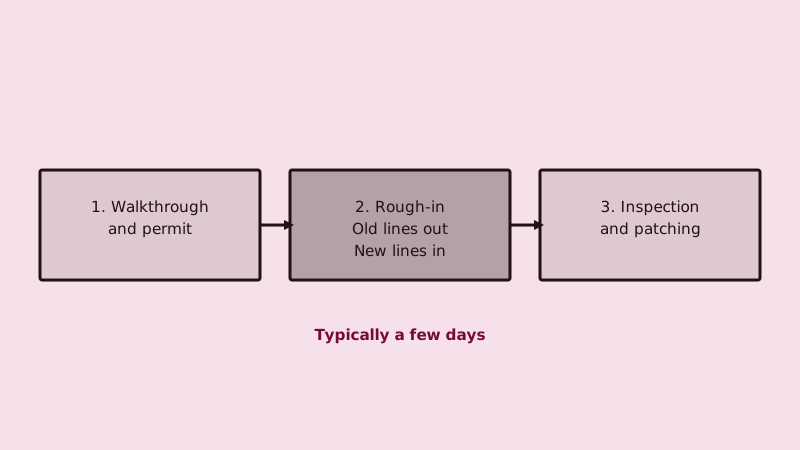
A typical complete repipe runs three phases: a walkthrough and permit, the rough-in where old lines are pulled and replacements installed, then inspection and patching. An average house tends to wrap up inside a few days; sprawling or awkward layouts stretch further.
The first morning goes to turning off the water, mapping where lines run and laying down floor protection. Fresh pipe then leaves the main valve and fans toward every fixture, favoring attic and crawlspace routes over finished walls. Fixtures get reconnected, the whole system takes a pressure test, and a city inspector examines it while the holes are still open. Bob Vila estimates repiping labor at about 15 hours for a standard house, which fits a multi-day job once drywall is counted.
Is PEX the way to go?
PEX is plastic tubing that bends. Crimp rings or expansion fittings hold it together, and it can be fed through walls and attics with very few joints. That flexibility is why most whole-house jobs now go this way. The plumber labels each run, connects it to a manifold, and pressure-tests before anything is covered.
Per foot, Bob Vila lists PEX between $0.40 and $2 and copper between $2 and $8. Pipe is the smaller share; labor and access decide the total. Rodents can gnaw PEX and sunlight breaks it down, so runs are kept covered. Two companion pages, PEX against copper and PEX repipe pricing, go further.
And with copper?
Copper is rigid. Each length is measured, cut and soldered at every elbow and tee. More hours go into it than into PEX, so quotes run higher, yet copper handles heat well, shrugs off rodents and has decades of track record. Plumbers sweat each fitting with a torch, so fire safety and wall protection matter.
Expect more open wall sections, since rigid pipe cannot bend through a tight stud bay. Some homeowners pay for copper on the visible stub-outs and use PEX behind the walls; ask what mix the quote assumes. Bob Vila says copper commonly lasts 50 to 100 years. Our guide to old-house plumbing costs covers mixed approaches.
Does a concrete slab change the plan?
With pipes buried in concrete, plumbers often abandon the old lines and run new ones above, across the attic and then down through wall cavities, instead of breaking up the floor. The flooring stays whole, though some wall sections open. This overhead route is a common answer on slab homes.
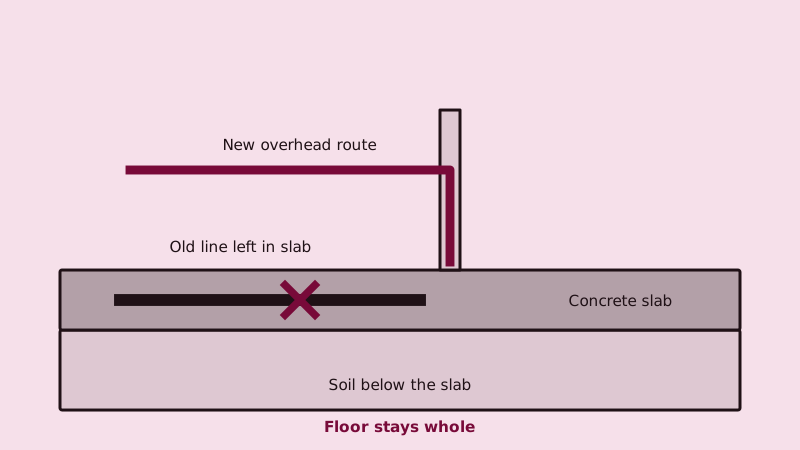
A few jobs still call for cutting the slab, for instance when one failing line cannot be rerouted. A leak under the floor is a separate question, handled in slab leak repair or repipe. Bob Vila's slab leak repair range is $630 to $4,400, which gives a sense of how a single repair compares with a complete job.
Which pipes are in homes around Whittier?
Postwar tract houses in Whittier, Downey, Norwalk, Pico Rivera and the neighboring cities often hide galvanized steel or copper in the water lines, while cast iron or clay takes waste away under the floor. Census figures put the median year built at 1959 in Downey, 1957 in Norwalk and 1957 in Pico Rivera, so a lot of the original plumbing is near retirement.
Inside galvanized pipe, rust builds until pressure sags and the water turns brown, long before any leak; see galvanized pipe replacement. Gray polybutylene tubing, found in some mid-era houses, is covered on the polybutylene replacement page. Local water adds a factor: Whittier city water averaged 250 mg/L hardness in 2025.
What does it cost to repipe, and how is the quote built?
Bob Vila's national numbers sit around $7,500 on average, with small jobs near $1,500. Its worked example, a three-bedroom 1,500 sq ft home, lands between $2,280 and $5,120. Labor at $45 to $200 per hour drives most of that, and cut walls mean drywall work billed on top.
Ask each bidder for a fixed price covering permit, pipe type, number of fixtures, drywall patching and whether painting is included. A repiping cost breakdown is on its own page. California wants a state license on the contractor once the job passes four figures. Whittier handles repipe permits through its Building & Safety Division, (562) 567-9320, while Downey, Norwalk and Pico Rivera each run their own counters.
How do you get the house ready?
Clear the areas where walls or ceilings will be opened: under sinks, closets, and the garage wall by the heater. Move furniture off the floors in the main bathrooms, photograph existing fixtures, and plan for a day or two without water. Arrange where the family and pets will be when drywall dust flies.
Ask whether the plumber coordinates inspection, drywall and paint, or whether you hire those separately. Keep a notebook of leaks and low-pressure fixtures so each is checked after the repipe. If you have copper with pinhole leaks, say which rooms, since that points to the sections to replace first.
Common questions
When is the water back for good?
Most average homes take a few days, though the exact time depends on size, access and whether drywall patching is included in the quote. Bob Vila bases its labor estimate on about 15 hours for a typical job. Taps will be dry during part of each working day, and the inspection comes after.
What questions belong in the bid conversation?
A repipe far exceeds $1,000, so ask for a license number, then confirm it at cslb.ca.gov. Then pin down the pipe type, who pulls the permit, whether drywall and paint are in the price, the fixture count, and how surprises behind a wall get handled.
Can I leave the house to the crew?
Someone over 18 should unlock the house every workday and join the final walkthrough with the plumber, so you hear what was done. If your job keeps you away, send someone you trust to let the plumber in. Move pets and valuables out of the work zones first.
The rest of our guides start from plumber whittier.