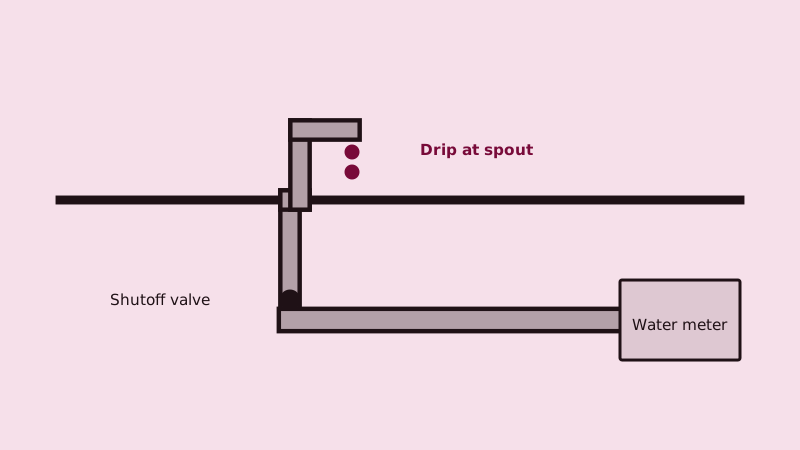
It can. The EPA's math says a drip every second means upward of 3,000 gallons gone in twelve months. That is real water, yet one drip rarely accounts for a bill that has doubled. When the total leaps, look at faucets first, then toilets, then the meter. Repairs for fixtures are covered by the faucet, sink and disposal plumber page.
How many gallons does one dripping tap lose?
The EPA's yardstick: a tap that drips every second sheds roughly 8 gallons daily, over 3,000 in a year, while a shower rose that drips ten times per minute loses over 500. That first figure is about 8 gallons a day, and it assumes the drip never stops. A faster drip, or a thin steady stream, costs far more.
Set that beside the bigger picture. Add up every leak in an average home and the EPA lands past 9,300 gallons in a year, so one faucet is only a slice.
Dollar cost hinges on your water rates. Many Whittier addresses are on the city's own water system, while other suppliers cover parts of the area, so read your bill for the rate and tier. A drip loses the same gallons anywhere. The price per gallon is what changes.
Why did my water bill suddenly jump this period?
Usually a leak, a houseguest, irrigation, a pool top-off, or a longer billing cycle. Set the bill beside last year's matching month before blaming a leak. The repeat offenders are hidden toilet leaks, sprinkler faults, faucets and showers, and the five below cover most cases.
Here are the likeliest causes of a spike:
- A flapper that leaks into the bowl, quietly refilling all day.
- A sprinkler valve stuck open or a broken head, often after the season changes.
- Faucets and showers that drip or run slowly.
- A leak in the buried pipe that feeds the house.
- Appliance supply such as a softener, heater or ice-maker line.
Further reading: why a bill climbs and high bills with nothing visibly leaking.
What does the meter test involve?
Start at the meter. Record the dial, use no water whatsoever for about two hours, and check it once more. A changed number tells you water is escaping somewhere. The EPA offers a second test: a family of four going through 12,000 gallons in one winter month likely has a serious leak.
Rule out ordinary uses during the test: dishwasher, washer, ice maker, sprinkler clock. If the dial keeps moving, shut the shutoff where the supply pipe comes into your house, then look at the dial once more. Stopped means the leak is indoors. Still turning suggests the buried pipe running from meter to wall.
Some meters have a small leak indicator, a triangle or tiny wheel that turns with flow. If it turns with everything off, you have your answer. Photograph the reading for your records and for any talk with the utility.
How do you know the faucet is the leak and not the plumbing below?
Watch where the water appears. Beads at the spout with the handle off mean the faucet itself. Wetness that shows only while the tap runs, at the collar of the spout or under the handle, is the faucet as well. Dampness all the time, with the tap idle, points lower: a supply line, a shutoff valve or the drain.
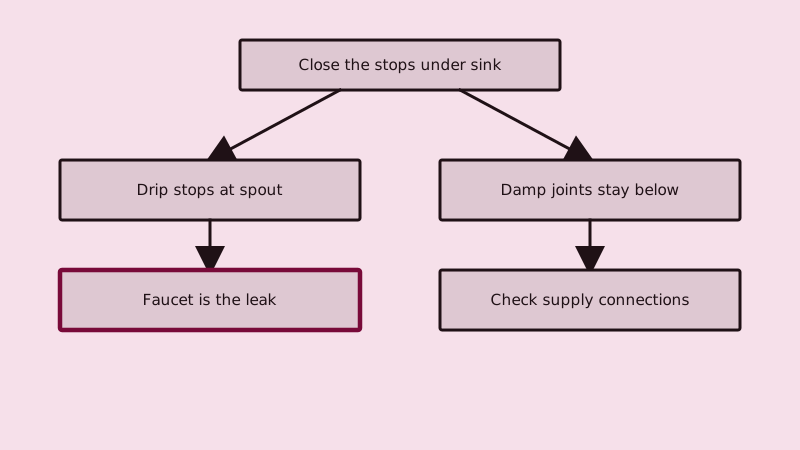
Press a strip of dry paper towel to each connection under the sink, then come back in an hour. The joint where the towel darkens is your culprit. Snug a loose supply nut by hand, then give it a small extra turn with a wrench, and replace the line outright if it is stiff, kinked or crusted.
Cabinet floors tell a story too. Swollen particleboard, a musty smell and rings on the cabinet base mean the leak has gone on for a while, and the repair list may grow to include the cabinet. Mention that in your request for a quote.
How do you end the drip?
Worn rubber causes most drips, whether washer, O-ring or cartridge. Turn off both stops beneath the sink, block the drain, lift off the handle and fit a matching new part. If water still beads at the spout, a corroded seat is the likely reason, which calls for a plumber.
The drip itself is covered in the sink faucet repair guide, and tub or shower versions are in general leaky faucet repair. Whittier's hard water is rough on seats, so expect to scrape scale off the parts.
When the repair would run close to the cost of a new faucet, replace the faucet. Figures are in faucet installation pricing.
Will the utility credit a bill that a leak inflated?
Maybe. Practices differ between suppliers, and some do not offer adjustments at all. Call the number on your bill and ask. The City of Whittier lists (562) 567-9530 for city water customer service. Other suppliers print their own numbers on the statement.
Gather meter readings, the date you found the leak and the date it was repaired. A plumber's invoice is the usual proof. Don't assume a credit before asking in writing: some suppliers adjust only the sewer portion, and others cap how many adjustments you get.
If the meter keeps moving and you cannot find a leak, a plumber for leaks can trace it. The quote form gets you a price on paper.
Common questions
What will one dripping faucet cost on the bill?
It depends on your rate and how fast it drips. The EPA reports about 3,000 gallons lost a year at one drip per second. Multiply gallons by your supplier's rate for a dollar estimate. A fast drip costs more, and a leaking toilet frequently costs more than a faucet.
Is a drip something I can stop on my own?
Yes, in most cases. Close the supply valves, cover the drain, remove the handle and trade the tired part, whether washer, O-ring or cartridge, for an exact match. Reassemble, restore water slowly and watch. A drip that persists, or valves that will not close, means calling a plumber.
What else makes a water bill too high?
Toilet leaks, sprinkler timers, buried line leaks, extra people in the house and long billing cycles. Check the meter after two idle hours. A reading that has moved means a leak. If it holds still, study usage habits and the read dates on the bill.
Is it okay to ignore a small drip?
You can, but it wastes money and wears the valve seat, so a washer-sized job can grow into a faucet replacement. Fix drips when you spot them, and look over faucets and toilets now and then, the way the EPA suggests checking flappers periodically.
The rest of our guides start from the plumber guide for Whittier.