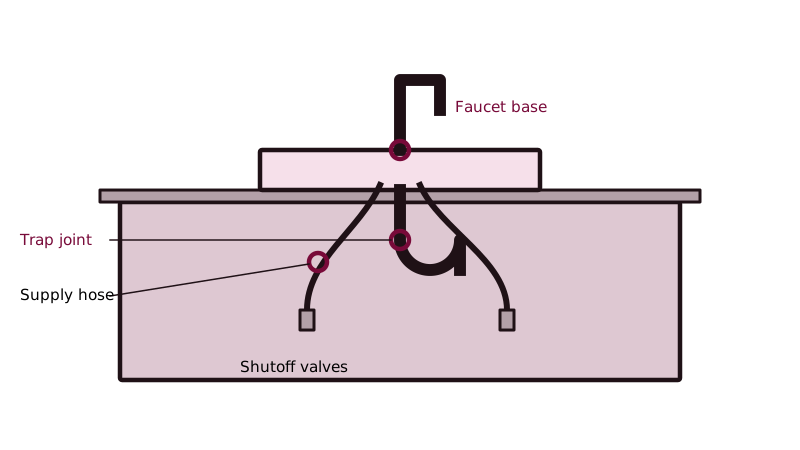
Open the cabinet, empty it, and look before you touch anything. A puddle on the cabinet floor can come from three places: the drain side (the curved trap and its slip nuts), the supply side (the two small hoses to the faucet), or the faucet and disposal above. If a disposal is involved, our page on garbage disposal repair is the better starting point. For a visit from a local plumber, use the price request form.
How do I find out where the leak is coming from?
Dry every pipe and the cabinet floor with a rag, lay dry paper towels underneath, then run the water and watch. A drip that appears only when the sink drains is on the drain side. A drip that shows with the tap running and no draining is on the supply side or at the faucet base. Torn towels show exactly where.
Take your time with this. Run the faucet on hot, then cold, then fill the basin and let it drain in one rush, since each test loads a different joint. Look at the top of every fitting as well as the bottom, because water runs down a pipe and drips from the lowest point, which may not be the leak. If the water is clean and cold, it is supply. If it has a sour smell, it is drain.
When is a leaking pipe under the sink a job for a plumber?
Call a plumber if the leak is from a copper or galvanized pipe in the wall, the shutoff will not close, the pipe is corroded or cracked, there are signs of water damage in the cabinet floor or the wall behind, or your fix did not hold. Water inside a wall is not a DIY repair.
Small repairs are yours to make. California requires a contractor license for work of $1,000 or more in labor and materials, and for any job that needs a permit, so replacing a trap or a hose does not cross that line, while re-piping a kitchen wall might. In postwar homes around Whittier, Downey and Norwalk, supply stubs coming out of the wall can be old galvanized steel or copper and may corrode inside. If one weeps at the wall, the repair involves the wall. See leaking pipe repair and fixing a leaking pipe joint for those cases.
What if the leak is from a supply line or shutoff valve?
Close the shutoff valve under the sink, then check the supply hoses. A line that drips at the nut can sometimes be snugged a little, but a cracked, bulging or corroded line should be replaced. New braided stainless hoses cost little and attach by hand and a quarter turn with a wrench.
Turn the shutoff handle clockwise until it stops. If water still flows, close the main for the house and call a plumber for the valve. When replacing hoses, measure the length and check the thread size at both ends. Do not reuse old rubber washers. If the leak is at the stem of the shutoff valve itself, tightening the packing nut a little may stop it, but an old valve may need replacement, and old valves can crack when turned. Whittier's city water averaged about 250 mg/L total hardness in the 2025 report, and hard water leaves crust on chrome fittings that can hide a slow weep.
How do I fix a leaking drain trap or slip nut?
Put a bucket underneath, loosen the slip nuts by hand, pull the trap apart, check the washers, reseat them, and hand-tighten the nuts plus a quarter turn. A cracked washer or a misaligned pipe causes most trap leaks. If the plastic is cracked or the threads are stripped, replace the trap, which is cheap.
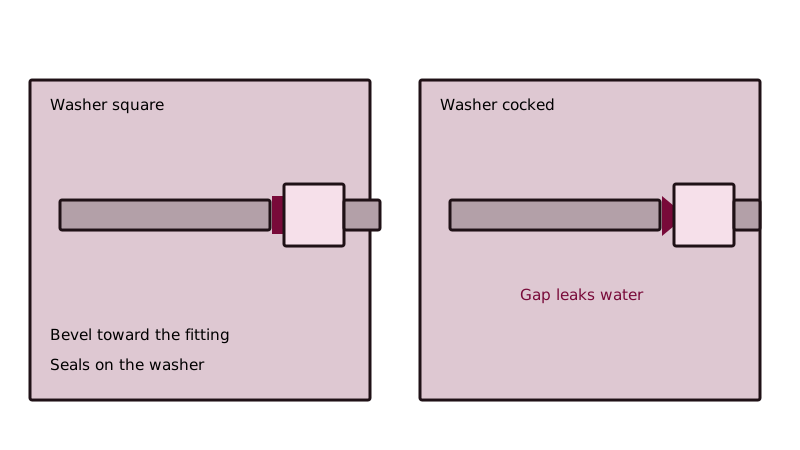
Slip nuts that were overtightened cause as many leaks as loose ones, since they warp the washer. Beveled washers go with the bevel toward the fitting. Make sure the trap is straight, with the pipes lined up, and do not use pipe tape on slip joints, because they seal on the washer. Run water and check again after five minutes. Any old chemical drain cleaner left in the trap can splash, so wear gloves and eye protection. A leak at a trap often goes with a slow drain, so read fixing a slow-draining kitchen sink once the leak is gone.
How do I limit the damage until the repair is done?
Close the shutoff valve or the main, empty the cabinet, wipe up all water, and put a shallow tray or a bucket under the leak. Run a fan or leave the cabinet door open to dry the wood. If cabinet particleboard is swollen or has a musty smell, it will not recover and may need replacement.
Check again in an hour and in the morning. A slow leak that is left alone for weeks can ruin the cabinet and cause mold. EPA's two-hour water meter test helps rule out leaks elsewhere in the home. If you see water spreading to a wall or a ceiling below, treat it as more serious and check water damage after a burst pipe. The home page lists the other work we arrange.
What if the faucet itself is leaking underneath?
Water running down from the faucet base points to worn O-rings or a loose mounting nut rather than a pipe. Tightening the mounting nut from below or replacing the cartridge or O-rings usually stops it. EPA says a faucet dripping once a second wastes more than 3,000 gallons a year, so it is worth fixing promptly.
Check the faucet model, since cartridge and O-ring parts are specific. If you cannot find the parts or the faucet is corroded, replacement may be cheaper than repair. See fixing a leaky sink faucet and fixing a leaky faucet for the steps, and faucet installation cost for the replacement side.
Common questions
Can I use plumber's putty or tape on a leaking drain pipe?
Putty and tape are not suited to slip joints or trap connections. A slip joint seals on its washer, so fix the washer and alignment. Pipe tape is for threaded supply fittings, and a thin wrap on the threads is enough. A sealant smeared over a cracked pipe only hides the leak for a short time.
Why does my sink only leak when I use the garbage disposal?
The disposal adds vibration and a larger flow, which can loosen its mounting flange, its discharge connection or the drain nuts. Check where the disposal meets the sink flange and where its outlet pipe attaches. If the disposal body leaks, it usually needs replacement. See unclogging a garbage disposal drain if it also backs up.
How tight should slip nuts be?
Hand tight plus about a quarter turn with pliers. Overtightening warps the washer and makes the leak worse. If a joint still weeps, take it apart and check that the washer is seated and the pipe ends are square and aligned.
Is a small leak under the sink worth fixing right away?
Yes. A small leak wastes water and soaks the cabinet floor, which can lead to mold and rot. EPA says household leaks can waste more than 9,300 gallons a year on average. A few minutes with a wrench is cheaper than replacing a cabinet.