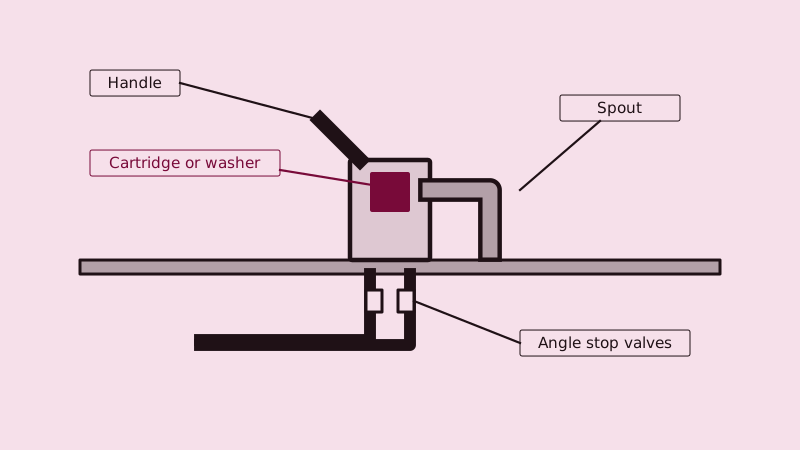
Dripping is a symptom of a tired seal. Compression faucets hold a rubber washer, single-lever ones a cartridge or a pair of O-rings, and newer ceramic-disc models a sealed cartridge. Closing the stop valves, opening the handle and fitting the matching part usually ends it. The EPA reckons a faucet losing a drop every second wastes upward of 3,000 gallons annually. The wider family of fixtures is gathered under faucets, sinks, showers and disposals.
Which design are you working on?
Count the handles first. Two knobs that spin several turns before they stop are almost always compression valves with washers. One lever that swings left and right and lifts up is one of the cartridge, ball or disc designs. Delta and Moen levers nearly always use a drop-in cartridge, and the model number often appears on its body.
Shoot a photo at each stage of disassembly. Pocket the old washer or cartridge and carry it to the shop; matching by eye at the counter beats guessing from a website. Buy the seat and spring too if the faucet is old.
Whittier water also matters. Whittier's own 2025 water report gives average total hardness as at 250 mg/L, close to 14.6 grains per gallon. Crusty scale on aerators, seats and cartridges is therefore common locally, and some drips are mineral buildup, not a torn washer. A white vinegar soak loosens light crust.
What stops a basin or kitchen faucet from dripping?
Shut both angle stops beneath the basin, then open the tap briefly to release trapped pressure. Stopper the drain. Lever off the decorative cap, back out the retaining screw, lift the handle clear, then draw out the cartridge or stem. Fit a new washer, O-rings or cartridge, assemble in reverse, and open the stops slowly while watching for beads of water.
Water bleeding from the base of a swiveling spout is another story: its O-rings are tired. Twist the spout upward and off, peel the rings away, smear plumber's grease on fresh ones and roll them into the grooves. Drips from the spout tip, however, point to the cartridge or the seat.
When a compression faucet keeps weeping after a new washer, the brass seat is probably eroded. A seat wrench can swap it. Once you are buying tools and seats, though, a new faucet may be the smarter spend; prices are discussed in what faucet installation costs.
What is different about a bathtub faucet or spout?
Tub valves live inside the wall, and many have no local shutoff, so the whole house supply goes off. Slide off the handle and escutcheon, extract the stem or cartridge with the right puller, and install a replacement. If the spout runs while the shower is on, suspect the diverter before the valve.
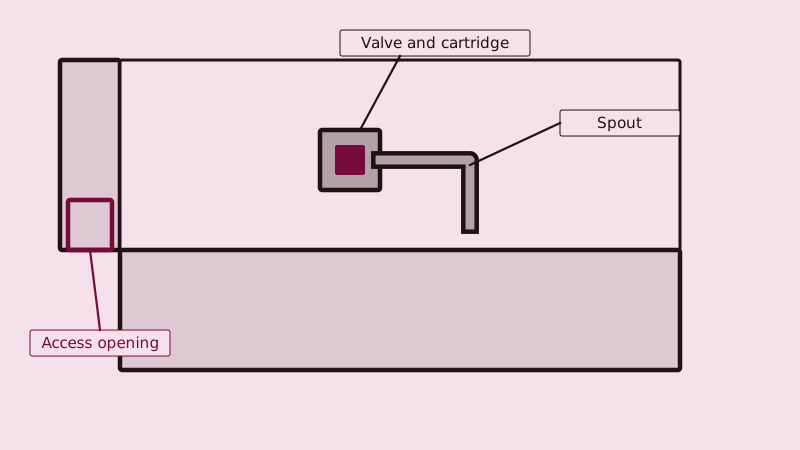
No access panel behind the wall? Sometimes the cleanest route is a neat opening cut in the adjoining closet or hall wall. Decide that before dismantling the trim, since a tub without a working valve cannot be used.
Still dripping with a new cartridge? Worn seats or a cracked valve body are likely, and replacement of the whole valve is a plumber's task. For tub valves in particular, there is a separate walkthrough on leaky tub faucets.
How do you plunge a shower drain?
Lift out the strainer, fill the drain area with a little water, press a cup plunger flat over it, and work it roughly twelve strokes while keeping the seal. If an overflow plate is present, hold a damp cloth against it. Hot water afterward washes loose debris along.
Slow after plunging? Hair is the usual cause, wound into a mat in the trap. A thin barbed plastic strip fished down the drain pulls it out better than suction. Avoid caustic liquid openers; they eat old fittings and can splash back if the pipe is still full.
Gurgling from several fixtures together, or water rising in a neighboring drain, means the blockage sits lower in the system. That needs a machine and a plumber. For milder sink-side blockages try clearing a bathroom sink.
What about a dripping hose bib outside?
Water from the spout points to a worn washer on the stem. A leak around the handle spindle means the packing nut needs a quarter turn or fresh packing. Close the interior shutoff for that bib if one exists, otherwise the main, then back remove the stem and put in a new washer.
A frost-free bib has a long stem running through the wall. If water trickles down the siding beneath it or inside the wall cavity, the stem may be split. That is not an at-home fix.
Take hoses off between watering sessions. Left attached, they keep the washer pressed under constant load.
Where is the line between DIY and calling someone?
Do it yourself when you can reach the stops, the faucet is a mainstream brand and the fix is only a washer, ring or cartridge. Phone a plumber when valves refuse to close, parts have fused with corrosion, water appears inside a wall, or the same faucet has dripped twice in a year. Legally, California wants a contractor license once a job reaches $1,000 in labor and materials, or whenever a permit applies.
A small drip rarely stays small, because cabinets absorb it unseen. Fill in the price request and a local plumber arranges to come by. The home page has the rest of our services.
Common questions
New washer installed and it still drips, why?
Likely the seat. If the brass ring the washer presses on has pits or scale, no new rubber can seal against it. Resurface or replace the seat, or the faucet. Where water is hard, scale on the seat turns up often enough that it is worth checking first.
What does a dripping faucet cost in wasted water?
For a faucet losing one drop a second the EPA gives over 3,000 gallons a year; a showerhead dripping ten times a minute loses over 500. Repair parts typically cost far less than the water adds up to on your bill.
Can the repair be done without shutting the water?
No. Water sprays the moment a handle or cartridge comes out under pressure, so closing the stops comes first. When the fixture has none, shut the house main and run the faucet until the line is empty, then begin. Skipping this step is how a cabinet fills with water.
What stops a showerhead from leaking at the arm?
Remove the head, wrap pipe tape clockwise around the threads on the arm, screw the head back snugly, and inspect the rubber washer inside it for cracks. The EPA suggests these same moves. A valve that drips when the shower is off is bigger and calls for a plumber.
Should an old faucet be repaired or replaced?
Repair when the body is solid brass and the fault is a washer or cartridge. Replace when finish is worn, the body is pitted, or parts are discontinued. The numbers can be close, so ask the plumber at the visit which one is cheaper for your fixture.