A trickle from the shower and a healthy kitchen tap point to something local, usually a clogged showerhead or a partly closed valve. Weakness at every fixture points upstream: a worn regulator, a main valve left part-closed, a narrowed pipe, or trouble out in the street. The visit we set up puts a local plumber and a gauge on your outdoor spigot, and the reading decides what happens next. Start with the price request form, or phone us in business hours.
What is the step-by-step way to fix weak pressure at home?
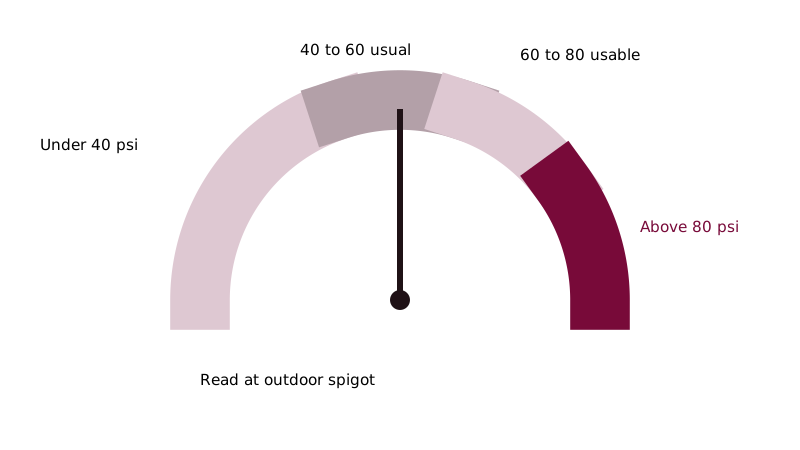
Go from free checks to paid ones. Make sure the main valve is wide open, scrub the aerators and showerheads, and compare against a hose bib. Next thread a pressure gauge onto an outdoor spigot. Below 40 psi counts as low, 40 to 60 is the usual residential band, and above 80 is too high. That one number picks your direction.
A normal gauge with one weak fixture puts the blame on that fixture. A low gauge everywhere is a reason to ask the neighbors whether they see it too, and to phone the water provider. In Whittier, city water customer service is (562) 567-9530. When the neighbors are fine, the cause is on your side of the meter, which is where a plumber begins. More causes are listed under low pressure in a house.
Why did the pressure fall off all at once?
An abrupt drop most often means a valve got bumped, a regulator quit, or water is escaping before it reaches the fixtures, so rule out a leak first. A dip at breakfast time can simply be neighborhood demand, when everyone showers together. Cold weather alone is seldom the cause here.
Run the meter test from the EPA: stop every use for two hours and see whether the dial turns. If it does, you have a leak, and leak repair takes priority. After plumbing work or a repair on the street, a stirred-up bit of debris can also jam an aerator or a cartridge, so unscrew the aerators and look inside before assuming the worst. For a single sink, low pressure at one sink has a short checklist.
Do pressure regulators wear out, and does every house have one?
They do wear out. Typical service life is quoted at 10 to 15 years, and hard-water minerals can cut that down. It is common where street pressure runs high, usually as a bell-shaped brass valve near the main shutoff, but it is not universal, and a house on gentle pressure may have none.
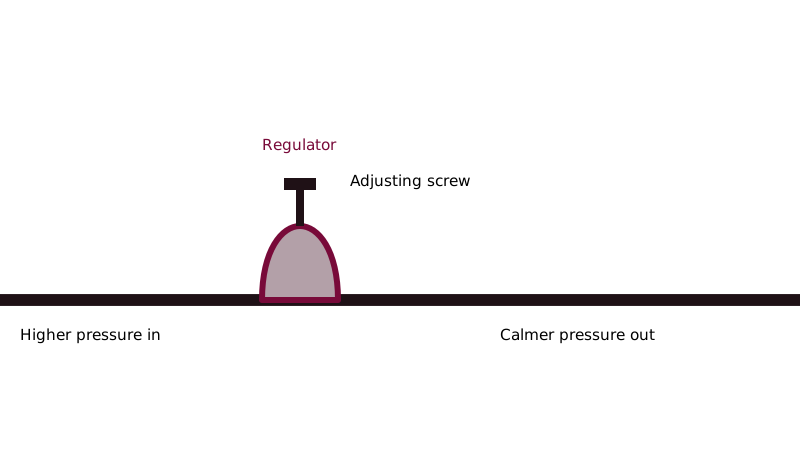
A tiring regulator shows itself as pressure that climbs between readings, thumping when a valve closes, a toilet that refills on its own, and washer hoses that burst early. To find yours, see where the regulator is located. Whittier's city water has a measured total hardness near 250 mg/L, or about 14.6 grains per gallon, per the 2025 consumer confidence report, which is hard water by most standards. That can encourage scale on small passages, including inside valves and aerators.
Is replacing a regulator a do-it-yourself job?
A homeowner can try, but the rules and the stakes favor a plumber. Past $1,000 in labor and materials, or whenever a permit is needed, state law wants a contractor license on the job, and an error on the main line floods the house. The valve is cheap and the installation is not.
The sequence is: close the main, cut into the service line, fit unions, then dial the pressure in against a gauge. It often involves dissimilar metals and an old valve that does not want to come loose. If the water heater has no expansion tank, a new regulator can trap pressure in the house, so ask whether one is needed. See adjusting a regulator valve for what a plain adjustment involves, and what a swap costs.
What should a new regulator run you?
Published guides list the valve at roughly $50 to $150 and professional labor near $200 to $500, so adding the two gives about $250 to $650 installed, and a buried or corroded main can run higher. Treat those as national guide numbers. Your real figure is the quote the plumber writes up.
Access sets the price. A valve on a garage wall is quick work, and one in a meter box or behind finished drywall is slower. Ask if the quote covers gauge readings before and after, and an expansion tank if one is needed. The page on regulator replacement goes deeper on the decision.
Why does the shower go weak before everything else?
Showers get the blame first because they use the smallest openings. Scale clogs the nozzle holes, and an old cartridge or a partly closed stop can add to it. EPA notes that WaterSense showerheads must use no more than 2.0 gallons per minute, down from the older 2.5 standard, so a newer head can feel weaker than the old one even when pressure is fine.
Let a removable showerhead sit in vinegar for a few hours, rinse it, and test again. If cold water is strong and hot is weak, the problem lives in the water heater, its shutoff or the hot line, not the shower. Our guide to low pressure at the shower walks through that split. Whole-bathroom weakness points back to the supply or a galvanized line that has narrowed inside; see galvanized pipe replacement.
Does weak pressure cause harm, and what about sprinklers and tankless heaters?
Low pressure itself is a nuisance, not a hazard, but what causes it can be. A leak, a failing main or a clogged line may need attention, and a shortfall can starve a tankless heater, which needs a minimum flow to fire. Sprinkler zones also drop in reach. High pressure is the more dangerous side, because it strains joints and appliances.
A tankless unit does not need its own regulator as a rule, but it does list a working pressure range in its manual, and the house should sit within it. If the unit shuts off at low flow, read tankless installation. Irrigation lines are separate from the house system in many yards, so test them apart. One aside, for anyone who searched for water and low blood pressure: that is a health question for a doctor, not a plumbing one.
How do I find a low-cost plumber nearby without getting burned?
Compare what each quote covers, not only the total. A low number that omits the gauge reading, permit costs or an expansion tank is not low. We set up the visit, and the price comes to you on paper first. Walk away from anyone demanding a large deposit before they start.
One state rule to know: contracts at $500 or more must be in writing. California also caps deposits, generally at 10 percent of the contract or $1,000, whichever is less, but confirm the current wording on the CSLB site before leaning on it. The home page lists the other jobs we arrange around Whittier, and repiping a house covers when an old supply line is past saving.
Common questions
Do most homes have a water pressure regulator?
No. Houses on high-pressure supply often carry one near the main. To find out, look past the shutoff for a brass bell-shaped body with an adjusting screw, or ask the plumber to confirm. If you cannot find one, say so when you book, and have the main shutoff cleared so it can be reached.
When does a regulator reach the end of its life?
Ten to fifteen years is the usual guess, less in hard water or a debris-laden line. Real life varies either way. Read a gauge every year or two. A reading that creeps up means the diaphragm or spring is going and replacement is due.
What psi should my home water pressure be?
Aim for 40 to 60 psi. Readings of 60 to 80 psi are usable but harder on fixtures and appliances. Above 80 psi breaks the California Plumbing Code limit, and water hammer, leaks and early appliance failures follow. Measure at an outdoor spigot, static with everything off, then again with water running.
Is a hidden leak a possible reason for weak flow?
It is. A leak upstream of a fixture robs flow, so the tap runs weak, and a break under concrete or inside a wall may leave nothing wet to see. If pressure sagged or the bill climbed, close everything, watch the meter, and phone a plumber when the dial turns.
How much time does tracing a pressure problem take?
Reading a gauge is a matter of minutes, and an obvious culprit such as a dead regulator or a plugged aerator can be named right there. A concealed leak or a galvanized line choked from the inside takes longer to prove. Before anything is cut, ask the plumber what will be tested and have the result written down.
In this section
- Water pressure and valves
Adjust a water pressure regulator with a gauge and a wrench: where the screw is, which way to turn, safe psi targets, and when a failing…
- Costs
What a plumber charges to install or replace a water pressure regulator: published price ranges, what raises the bill, and how to compare…
- Regulator replacement
Signs a pressure regulator has failed, how a plumber tests and replaces one, typical guide costs, and why hillside homes in the Puente…
- Water pressure and valves
Low water pressure has a short list of causes: a half-open valve, a failing regulator, scaled pipe, a leak or a supply issue.
- Water pressure and valves
Most water pressure regulators sit on the main line where it enters the house, near the shutoff.
- Water pressure and valves
Weak flow in a Whittier area home usually traces to a valve, a regulator, scale, old galvanized pipe or a leak.