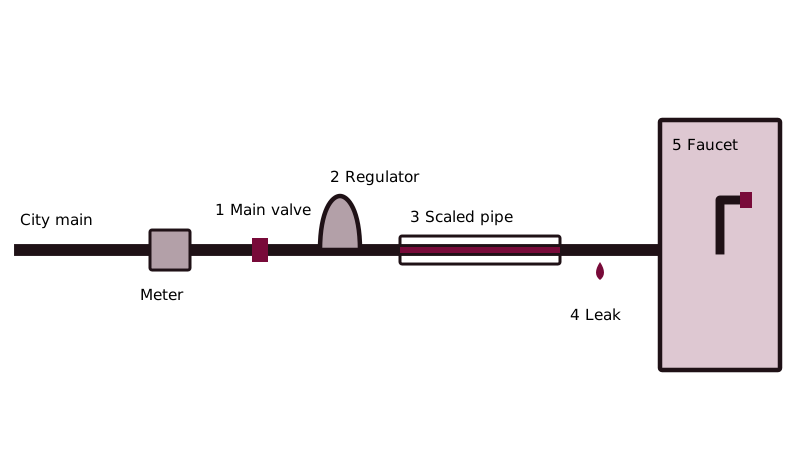
The place where the weakness appears tells you the cause. A single fixture blames its own screen or cartridge. Hot water alone blames the heater side. If every tap runs weak, the culprit is a main valve, the regulator, choked or rusted pipe, a hidden leak or the supply itself. Repairs are on the low water pressure overview; this page sticks to causes.
Which clue tells me where the pressure is being lost?
Try three tests: a single fixture, hot against cold at one tap, and an outside hose bib. One weak fixture suggests a local clog, weak hot alone suggests the heater side, and weakness everywhere, outdoors included, suggests the incoming line, regulator or supply. Screwing a gauge to the bib gives you a hard number.
Match your symptom to a row below:
| Symptom | Probable cause | One sink or shower only | Clogged aerator or showerhead, worn cartridge |
| Hot water only | Sediment in the heater, partly closed heater valve, corroded hot line | ||
| Whole house, hot and cold | Main valve, regulator, corroded pipe, leak or supply | ||
| Sudden drop everywhere | Closed or failed valve, burst pipe, supply interruption | ||
| Slow decline over months | Scale or corrosion narrowing old pipe |
Then read the dial. A good many homes read between 40 and 60 psi, while section 608.2 of the state code stops at 80. A reading far under the usual range points upstream, while a normal reading with weak taps puts the restriction inside the house.
Is a half-open valve starving the house?
Possibly, and checking it is free. The main shutoff at the point of entry, the meter valve and the valve beside a regulator can all be left partly closed after plumbing work, and a gate valve open only halfway will starve every fixture. Open each one fully.
Turn the handle gently. A round wheel opens counterclockwise, while a lever on a ball valve means open when it lines up with the pipe. An old gate valve that refuses to move, or a stem that wobbles, should not be forced; a stuck main is a plumber's job.
If pressure vanished right after a contractor or the utility visited, put this first on the suspect list. Look at the heater's shutoff and the small angle stops under fixtures as well.
Can a worn regulator drag pressure down?
It can. A regulator worn out or clogged with grit can choke flow and leave the house running well below street pressure. The sign is a low gauge reading while the supply ahead of the regulator is fine. Many houses around here have one near the main shutoff.
With a gauge, read both sides of the regulator if each is reachable; if not, a plumber can handle that. One that drifted low can sometimes be adjusted, and a dead one gets replaced. We explain adjusting a regulator, finding the regulator and swapping it out.
Does old or scaled pipe lower the pressure?
It does. Galvanized steel corrodes from within, and mineral scale shrinks the bore until flow drops even though standing pressure looks normal. That is the typical slow slide over months or years. The USGS says long-term scale can narrow pipes and lower pressure, and Whittier's city water averaged about 250 mg/L hardness in 2025, which the USGS ranks as very hard.
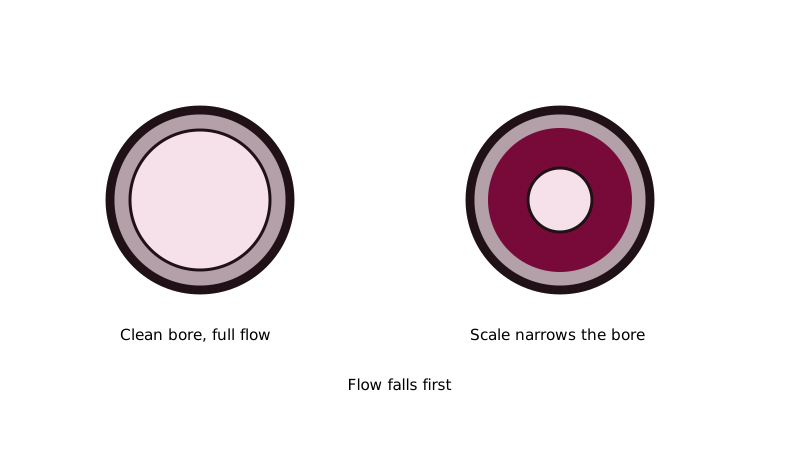
Postwar houses are where old steel turns up. Census estimates give median build years of 1957 for Norwalk and Pico Rivera and 1959 for Downey, so galvanized sections are plausible in parts of this area. Look for rusty or brown water, flow that has worsened gradually, and weak fixtures farthest from the main. For replacement choices, open galvanized pipe replacement, and slowing scale buildup helps new plumbing last.
Could a leak or an outside problem be responsible?
Either one. A leak in the yard line or inside the walls lets water escape and drops pressure at the fixtures. A supply problem, such as utility work, a main repair or heavy demand, can lower pressure for an entire neighborhood. Test for a leak by watching the meter while every fixture is idle.
Ask neighbors if they notice it too, and contact your water supplier, since more than one serves parts of this area. City of Whittier water customers can phone the city's water customer service at (562) 567-9530. A sudden drop alongside a wet spot, a loud hiss or a bill spike points to a leak.
Hillside houses, such as those in parts of La Habra Heights and Hacienda Heights in the Puente Hills, can see lower pressure at higher elevations, since water loses pressure as it climbs. Such homes sometimes rely on booster pumps or regulators, and a plumber can say what suits your lot.
What if only one faucet or shower is weak?
Suspect a clogged aerator, a mineral-caked showerhead or a tired cartridge. Unscrew the part, leave it soaking in vinegar for an hour, rinse it and fit it back. If a faucet is still weak with a clean aerator, look at the cartridge or the angle stop next.
Single-fixture cases have their own pages, a sink with weak flow and a shower with weak flow. Hot-only trouble is explained in weak hot water from the heater, and why pressure drops casts a wider net.
When should a plumber be called in, and how do I set that up?
Make the call when a gauge confirms low pressure at the hose bib, when you suspect a failed regulator, stuck main, hidden leak or corroded pipe, or when pressure fell suddenly along with other signs. Put the details in the price request form; a plumber nearby then visits and quotes in writing first.
Pass along the gauge reading, where the weakness appears and when it began. Whittier and the nearby cities we cover are named on the service areas page, and the home page shows the rest of what we do.
Common questions
What counts as normal water pressure at home?
Typical houses land near 40 to 60 psi; the plumbing code's upper limit is 80. Measure with a hose-thread gauge on an outdoor spigot while nothing else uses water. A plumber can say whether that reading suits your fixtures and appliances.
Will low pressure force me to replace pipes?
Often not. A half-open valve, a clogged aerator, or a regulator in need of adjustment costs little to fix. Only corroded or scaled pipe calls for replacement, and testing plus inspection by a plumber can confirm it before you commit.
What explains a sudden loss of pressure?
A sudden drop usually comes from a closed valve, a leak or burst pipe, a failed regulator or an interrupted supply. Check the main valve, look for damp spots and watch the meter with the house idle. If the cause stays hidden, call a plumber.
Would a booster pump solve it?
Sometimes. A pump helps when the supply itself is weak, as on a hillside lot, yet it cannot cure a restricted pipe or a failed valve. Find the cause first, since pushing water through a clogged pipe only adds strain.
Can hard water be behind it?
Not directly, though scale inside pipes and fixtures narrows them over time and cuts flow. Where water is very hard, clogged aerators and showerheads are common, and old galvanized lines can restrict. Cleaning fixtures and treating the water can help.
References
- USGS, Hardness of water
- City of Whittier 2025 Consumer Confidence Report (State Water Board)
- California Plumbing Code, section 608.2 (80 psi limit)
- US Census ACS 2024 5-year estimates, via Census Reporter