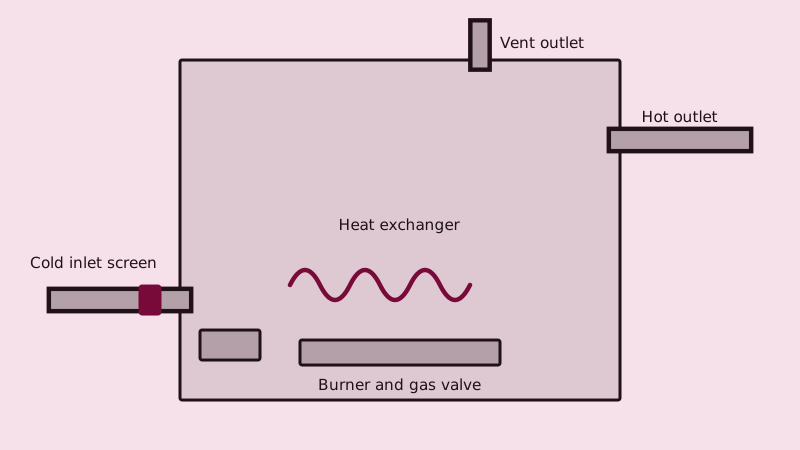
Tankless service means flushing scale from the heat exchanger, checking the vent, gas and sensors, and reading stored error codes; repair means replacing whatever failed, from a flow sensor to an igniter to the exchanger itself. Wider coverage of tank and tankless work lives under water heaters, and this page stays with the on-demand units.
What happens during a tankless water heater service visit?
The plumber isolates the unit with service valves, pumps a descaling solution around the heat exchanger, rinses it, then checks the intake screen, venting, gas pressure, ignition and flow sensor, and reads the error history. The whole point is to remove scale before it chokes flow or overheats the exchanger.
One guide prices a flush at $100-$200 and recommends doing it annually. Manufacturers set their own intervals and procedures, so follow the manual, and ask any contractor which one they follow. Isolation valves make this far easier, and a unit installed without them may need a valve kit added first.
The visit also covers things owners cannot see: whether the vent is tight, the condensate line from a condensing unit is draining, combustion looks right on a gas unit and the cold-water inlet screen is clean. Gas and vent adjustments belong to someone with the California contractor license, not to the owner.
Does hard water in southeast LA County matter for a tankless unit?
Yes, because heat exchangers are small and scale hurts them quickly. The City of Whittier's 2025 report lists total hardness averaging 250 mg/L, near 14.6 gpg. Golden State Water's Norwalk system reports an average of 310 mg/L, and La Habra Heights County Water District reported 309.8 mg/L for 2023.
Hardness varies by supplier and often by street, and not every address in each city is served by those utilities. Look at your bill for the company, then at that company's annual water quality report. Where water is hard, many owners add a scale-control or softening step; your choices are set out in hard water scale prevention.
Higher hardness means descaling at shorter intervals, not a reason to avoid tankless units. If your heater shows scale-related codes, ask about both the flush and what is feeding the problem.
Which checks can I do before making a call?
Check that the unit has power or gas, that the gas shutoff and water valves are open, that the display is not showing a code, that nothing blocks the vent termination outdoors and that the inlet screen is free of debris. Also confirm the faucet is flowing enough to trigger the heater. Do nothing involving gas lines.
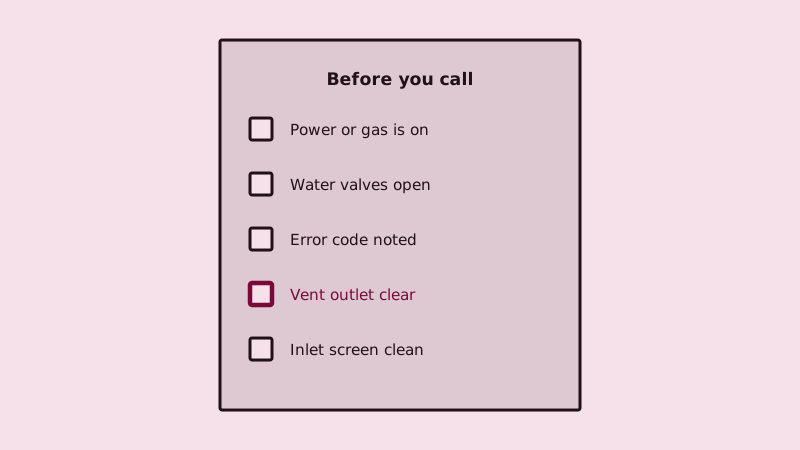
Safe checks for an owner include reading and noting the error code, power cycling the unit once using the manual's instructions, and rinsing the cold-water inlet screen if the manual describes it. Should you ever detect gas, walk out first, then reach SoCalGas at (800) 427-2200 from the curb, while 911 handles anyone at risk. SoCalGas supplies every city we cover.
When a carbon monoxide alarm sounds near a gas unit, everyone goes outside and 911 gets the call. Venting and combustion faults can produce CO, so a tankless heater showing a vent-related code should be treated seriously and not reset repeatedly.
Why would a tankless heater need repair?
The common faults are scale buildup, a dirty inlet screen, a failed flow sensor, a worn igniter or flame sensor, a failed thermistor, a tripped safety from blocked venting, and a cracked or scaled heat exchanger. Most announce themselves through an error code, tepid water or a heater that lights and quits.
On a gas unit, ignition and venting problems dominate. On an electric unit, heating elements and control boards are the repeat offenders. Two patterns are worth recognizing:
- Water that surges hot and cold, or fades during a long shower, can mean scale, a restricted inlet or a flow below the unit's minimum activation rate.
- No hot water at a faucet used with a low trickle often means the flow is too small for the sensor to trigger the burner or elements, which is a design limit more than a defect.
Error codes are specific to the maker; the owner's manual translates them. Write the code down before resetting anything, since a plumber can use it.
What do repairs usually cost?
One national guide lists tankless repairs at $100-$650 with an average of $375, and another gives a range of $150-$1,200 with most owners paying $300-$700. Parts such as a flow sensor, igniter or thermistor sit at the low and middle end. The heat exchanger and control board are the expensive end.
Labor in these guides is $50-$200 per hour, and one source says most jobs fit in one to three hours. These are national averages; local bids may differ, so see tankless water heater repair cost for the breakdown by part. One source finds repair sensible on a unit younger than roughly ten with a minor fault; a major failure on an old unit may favor replacement, as the guide suggests. For replacement figures, installation cost for a tankless heater lays out the other side.
Which signs call for a professional?
Call when an error code repeats after a reset, when water never gets hot, on any whiff of gas or exhaust, at any sign of water escaping the cabinet, or when the heater has not been descaled for years. Scale and venting problems get worse and more costly when ignored.
To get a price, fill out the price request form and list brand, model, fuel and the error code if you have one. Someone local gets arranged to quote the job. Still undecided on the type of heater? Tank versus tankless is worth a read first.
Common questions
How long is the heater out of action?
A flush and inspection on an accessible unit with isolation valves commonly takes an hour or two. Repairs vary: a sensor or igniter swap is often one to three hours, according to one guide, while a heat exchanger or board may need parts ordered. We cannot quote exact times.
Which questions go to the contractor first?
Whether they service your brand, which flush procedure and solution they use, if isolation valves exist, how they read error codes and whether parts and labor are itemized. Run their contractor license through the CSLB lookup, then request the price in writing before anyone opens the cabinet.
Is an adult needed on site?
Preferably. Somebody has to open the way to the unit and its shutoffs, and hot water is unavailable while it is flushed. Move boxes away from the heater, keep pets elsewhere and set out the manual and warranty paperwork. Move boxes away from the heater, keep pets elsewhere and set out the manual and warranty paperwork.
Can a tankless heater be flushed by the owner?
Some owners do it with isolation valves, a small pump and the descaling solution the manual calls for. It is optional work, not a legal requirement. Gas, venting and combustion adjustments are not owner tasks, and a unit without isolation valves calls for a plumber instead.
The rest of our guides start from Rio Hondo Plumbing.