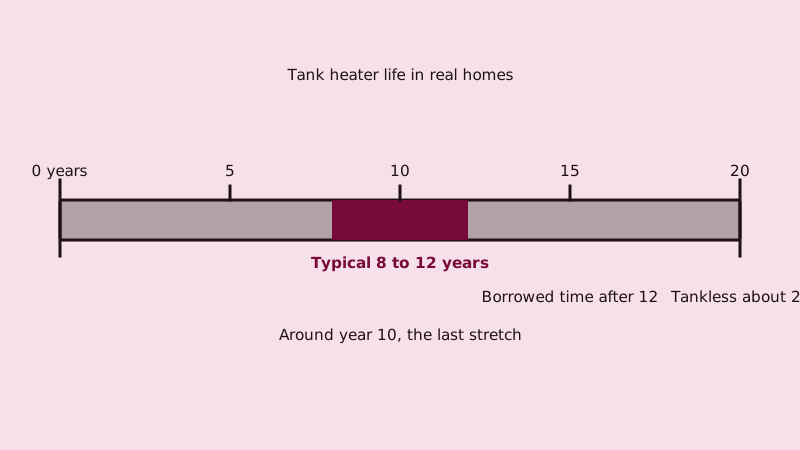
Plan to replace a tank heater sometime in its ninth through twelfth year. The Department of Energy's figure of 10 to 15 years, as relayed by a manufacturer's guide, describes ideal conditions, and that guide says homes rarely get there. Hard water, skipped maintenance and an anode rod that has dissolved all cut it shorter. For fixes that stop short of replacement, start at water heater repair.
How long does a tank heater normally last?
Eight to twelve years is typical in an actual home. At ten it is entering its last stretch, and between twelve and fifteen it is living on borrowed time. Published guides rate heat pump models at 10 to 15 years, and the Department of Energy says tankless units can last more than 20 years.
Three variables explain the spread: water quality, upkeep and sizing. An undersized tank cycles hard. A tank never drained collects sediment that overheats its bottom. One whose anode rod is used up starts rusting from within, and the leak that follows cannot be patched.
To learn how old yours is, check the data plate on the heater's side. The serial number encodes a month and a year, and the maker's website can decode it.
Is Whittier's water hard on a water heater?
Yes. A manufacturer guide credits hard water with taking 2 to 5 years off a tank. In the City of Whittier's 2025 water quality report, total hardness averages 250 mg/L, which works out near 14.6 grains in a gallon. Scale coats the tank floor and the heating element.
Hardness depends on who supplies you. Golden State Water, Suburban Water Systems and several city systems serve different slices of Whittier, Downey, Norwalk and La Mirada, and each publishes its own figures. Golden State's Norwalk system averaged 310 mg/L in 2025, its Artesia system 191. Look up your own supplier's report before assuming.
At home, hardness reveals itself as pops and a low rumble when the burner runs, showers that go lukewarm early, and chalky crust on aerators. Sediment causes the same symptoms, and they show up before failure does.
What does a dying water heater look like?
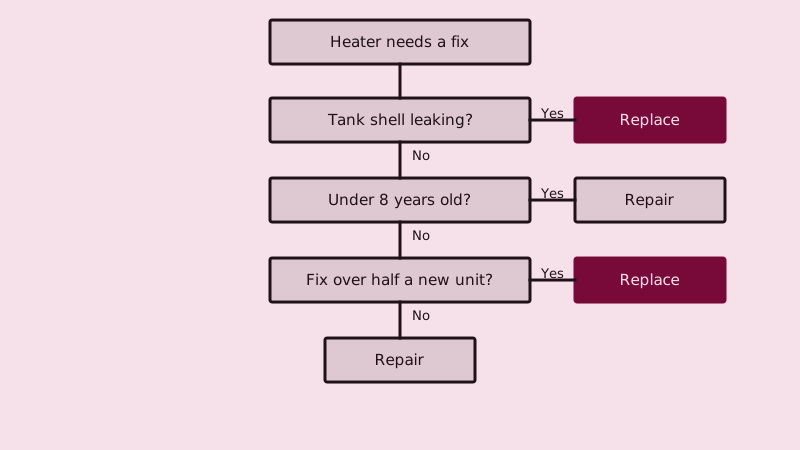
Watch for water at the base, rust-tinted hot water, popping or rumbling, shorter hot supply, and a unit older than ten that keeps needing fixes. If the tank shell itself is leaking, and not just a fitting, the discussion is over: replace it.
- Puddle at the foot: if it is the tank shell weeping, the heater is done.
- Rust only in hot water: corrosion inside the tank.
- Banging or rumbling: hardened sediment cracking as the water warms.
- Hot water that runs out early: sediment taking up tank volume.
- Rising bills plus repeat repairs: efficiency fading.
Cold showers with no other symptoms may be a simple fault: see no hot water at all. If water is spreading over the floor, stop the cold feed at the valve above the heater, and turn a gas heater's control knob to off.
Does it make sense to repair an old heater?
Beyond ten years, replacement often wins when a fix runs past about half what a new unit costs. Under eight years, a new thermostat, element or valve usually pays off. A heater whose tank shell leaks is done at any age, so do not pour money into repairing it.
Get two written numbers, one for each path. Replacement cost shows typical ranges, and tank versus tankless helps if you are considering a different type. Tankless frequently needs bigger gas piping and different venting, which shifts the budget.
A heater swap typically brings a permit, which the plumber normally files. Details sit on the permit guide for water heater replacement. One regulatory note: the South Coast air district's June 2025 vote left Rules 1111 and 1121 unchanged, so those rules bring no zero-NOx heater requirement.
Does upkeep really add years?
Somewhat. A published guide advises inspecting the anode rod at intervals of 3 to 5 years and replacing it once it is worn to the core wire, which can add about 2 to 4 years. Emptying the tank each year, or twice yearly where water is hard, flushes out sediment.
Anode swaps need headroom above the tank, and some rods are seized. Before you try one, read about replacing the anode rod. A closed system's expansion tank also wears out, as expansion tank replacement explains.
Upkeep slows the damage. It does not rebuild a lining that has already failed.
Should a 15-year-old heater get flushed?
It is a judgment call. Sediment in a tank that old is packed hard, and opening the drain can leave the valve weeping or clogged. A flush will not restore a spent anode or lost metal. If the heater still works, a plumber can drain it and say candidly what condition the tank is in.
A brittle plastic drain valve is worth swapping for brass before any draining. At this age, a flush mostly buys time while you plan for a new unit. Swapping before a leak beats swapping after, since a failing heater in a hallway closet can ruin floors.
Ready for a figure on a new unit? Request a quote and include the tank's age, fuel and size. The home page explains the process.
Common questions
What lifespan is realistic for a water heater?
Between 8 and 12 years for most tank models in daily use and up to 15 in favorable conditions; the Department of Energy says tankless units can last more than 20 years. Water quality, sizing and upkeep move the number either way. Beyond ten years, expect repairs to start stacking up.
Should a ten-year-old heater get repaired?
Maybe. If the tank is not leaking and the repair is minor, fixing can make sense. When the repair estimate creeps toward half a new heater's price, or rust shows, replacing is usually the better spend. Ask for both numbers in writing before choosing.
What happens if you never replace a water heater?
It runs until the tank rusts through, then leaks. Failure is rarely gradual, and the flood can damage flooring and drywall. Replacing on your own schedule, with the price in writing, is usually cheaper than an emergency call after a leak.
Does a tankless water heater last longer?
The Department of Energy says tankless units can last more than 20 years, longer than a tank's 8 to 12. It still needs descaling in hard-water areas like Whittier, and it carries a higher price at purchase, so compare the lifetime cost with a written quote for each type, not just the lifespan.
References
- US Department of Energy, Energy Saver Guide 2022 (storage heaters 10 to 15 years, tankless more than 20)
- Lennox, How Long Can a Water Heater Last
- City of Whittier 2025 Consumer Confidence Report
- Golden State Water, Norwalk system water quality report (2025 hardness)
- Golden State Water, Artesia system water quality report (2025 hardness)
- SCAQMD, Rules 1111 and 1121 board action, June 2025