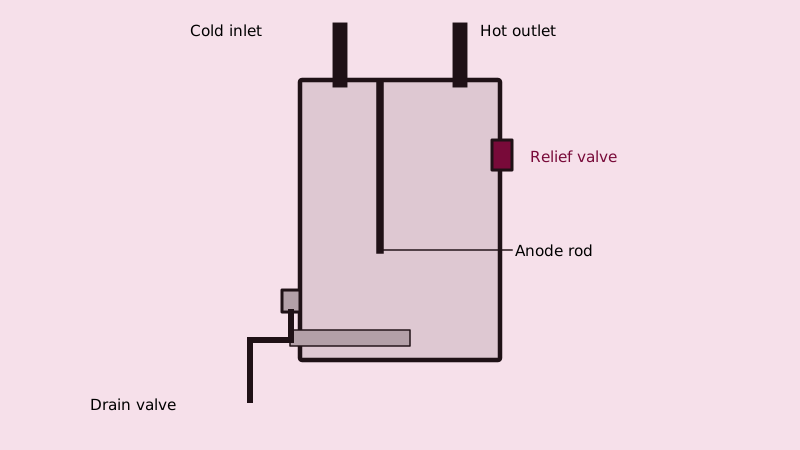
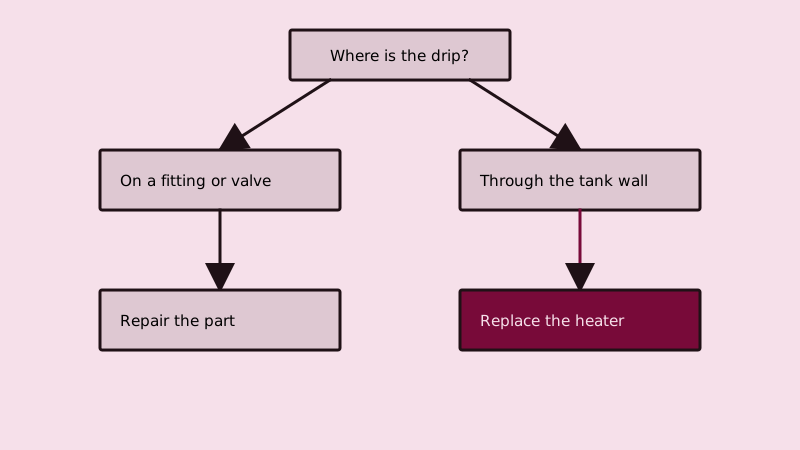
Your options turn on where the drip begins, in the steel tank or in a part bolted to it. Attached parts (supply fittings, drain valve, relief valve, an electric element gasket) can be replaced. Once a tank weeps through its shell the steel is spent, so you need a new heater. For the whole range of jobs, head over to the water heater repair hub; the home page links onward to the rest.
Is it really the heater dripping?
Not always. In a garage or closet, drips arrive from a condensation line, a hose bib, a window track or a ceiling pipe. Dry the floor and the tank, tape a strip of paper towel under each joint and check back in ten minutes. The towel that darkens first marks your source.
Common impostors and real sources, side by side:
- Sweating on a cold, humid day: a film of moisture all over the cold pipe, nothing dripping from a single point.
- Relief valve discharge: water trickling along its drain tube.
- Pipe connections on top: beads of water around the cold inlet and hot outlet nuts.
- Element covers on an electric tank: damp insulation behind the side panel.
- Bottom of the tank: rust streaks and water coming from the seam at the base.
Which leaks are repairable?
Parts can be swapped; the shell cannot. Epoxy, putty and clamps fail under heat and constant pressure, so nobody should sell you one as a lasting fix. If your leak sits in the top or bottom group below, a plumber replaces the part and the heater keeps going.
| Source | Outcome |
|---|---|
| Cold or hot connection | Redo the joint or fit a new flexible connector |
| Drain valve at the base | Swap the valve |
| Relief valve | New valve, plus a search for why it opened |
| Electric element flange | New gasket or element |
| Tank wall, seam or bottom | Heater needs replacing |
Do not plug a relief valve to stop it dripping. It is the safety release. For causes and parts, try replacing a relief valve and the expansion tank pages.
How do you slow the damage tonight?
Shut the cold supply valve at the top, remove the heater's power and run one hot tap indoors so the tank drains lower. Still flowing? Close the whole-house main. Let a steaming heater cool before you touch any pipe, since hot water scalds fast.
In order:
- Turn the cold inlet handle clockwise. A lever shuts when it crosses the pipe.
- Electric tank: breaker off. Gas tank: turn its dial to the pilot or off mark.
- Catch the drip in a pail, then dry the floor before it wicks into the wall.
- Notice gas near the unit? Step outdoors and dial SoCalGas on 1-800-427-2200.
- Snap a picture of the rating label so you have the model, serial number and capacity.
For a heavy leak after hours, urgent water heater repair sets out what to expect.
Fix it or replace it?
Replace the heater if the tank itself leaks. If the leak is an outside part but the heater is old, rusty at the base or has been patched before, price the repair against a new unit. The label's serial number usually carries the build date, which tells you the age without guessing.
A plumber sizing this up will ask four things: how old it is, whether the water has turned brown, what fuel it uses and whether there is an expansion tank near the cold inlet. Have those answers ready. Tankless models fail differently, through heat exchanger scale, a loose union or a clogged condensate line, and most of that work is for a contractor; if a switch tempts you, tank versus tankless compares them, and replacement costs show the prices.
What does Whittier water do to a heater?
It leaves scale behind. The City of Whittier's 2025 water quality report shows total hardness at 250 mg/L on average, ranging from 230 to 270, which works out near 14.6 grains in each gallon. The USGS scale starts "very hard" at 180 mg/L, so Whittier water lands above it. Minerals bake onto elements and settle in the tank bottom.
Which supplier you have matters, because several serve parts of the area, and each publishes a report of its own. In a hard-water home, heaters tend to rumble, lose capacity and burn more fuel for the same shower. Flushing sediment from the tank yearly and replacing a spent anode rod slow the corrosion that ends in a leak. A softener tackles the cause: see water softener installation.
Does it matter if it is a Rheem, Whirlpool or Bosch?
For parts and warranty, yes; for the leak test, no. Each maker has its own element sizes, valves and control boards, so the plumber needs the exact model from the rating plate. Warranty terms differ, and some require the installer to hold a contractor license, so read yours before anyone starts and phone the maker when the tank is young.
Bosch is best known here for tankless models, which carry their own error codes and service rules, so a manual or the support line at the manufacturer counts more than usual. Keep the purchase date, any registration and the permit record from the original install in one folder.
What do permits, gas and bracing have to do with it?
A heater change-out requires a city permit, while gas piping is regulated work; a homeowner's job ends at snugging an exposed fitting. Whittier's Building & Safety Division handles permits at (562) 567-9320. California also expects earthquake strapping on water heaters, which a proper install includes.
The permit guide walks through the steps. Contractor licensing in California applies to $1,000 jobs (labor plus materials) and to anything permitted; CSLB's site has a lookup. Ask for the estimate in writing before work starts.
Common questions
What might a leak repair run me?
A small part costs much less than a heater, and a leaking tank means buying a heater. I have no verified local price for repairs, so I am not printing a number. When you call, ask what the service fee covers and how the hourly rate works, then compare against the cost guide.
Can I keep using a heater that leaks?
Only until you can shut it down. A fitting that drips can soak a wall or rot the stand, and a wet burner compartment on a gas heater is a hazard. Close the cold valve and cut the power until someone looks at it. Smell gas, and you should leave and call SoCalGas.
Can I fix a Rheem or Bosch heater on my own?
Tightening an exposed nut or swapping a flex connector is within reach on any brand. Gas valves, burners, venting, tankless internals and any replacement are contractor work, and replacement needs a permit. Before anything, note the model and warranty terms, because repairs by the wrong person can void them.
Why would a relief valve keep weeping?
Pressure or temperature inside the tank is rising too high. A faulty thermostat, a sealed system lacking the expansion tank it often needs, or street pressure beyond 80 psi (the code limit, CPC 608.2) can each cause it. A new valve on its own may not cure it, so have the cause found.
What if the heater leaks and also gives no hot water?
Stop the leak first: close the cold valve and kill power. A tank that has drained will trip an electric element or put out a gas burner, so a dead heater may only be an empty one. After the repair, restart it from its label instructions. More checks are in the cold shower guide.