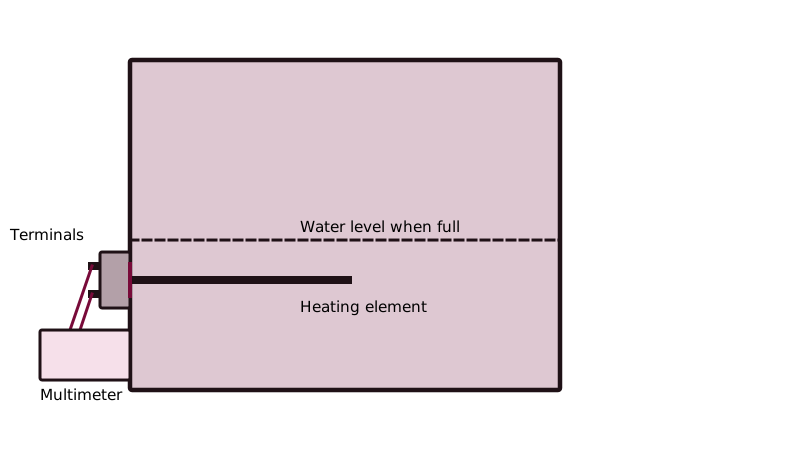
Heating elements exist only in electric tanks. When an electric heater goes lukewarm or cold, a burned-out element is a leading suspect, and swapping one is a repair that suits a handy owner, so long as the power is killed and double-checked. Running on gas? Head to water heater repair instead.
What tells you an element has burned out?
Clues include cold water throughout (often the upper element or thermostat), a thin supply of warm water that vanishes quickly (often the lower element), a tripping breaker, or slow recovery. A multimeter reading across the element terminals settles the question.
An electric tank carries a pair. The top one warms the upper section first and passes the job down, so losing it usually means no hot water, whereas losing the bottom one leaves a small reserve. Bad thermostats, a tripped reset button and loose wiring can imitate both, so measure before you buy.
With a gas unit, elements are irrelevant; typical gas faults are explained under water heater on but no hot water and thermocouple replacement. SoCalGas supplies every city we cover.
Why do elements fail, and does Whittier water play a part?
Age, sediment burying the bottom element, dry firing and mineral crust that traps heat in the metal all kill elements. The city's 2025 water report gives average hardness near 250 mg/L, so scale is a plausible local cause. An annual tank flush slows it.
When the lowest element dies again and again, silt is probably burying it. Flush the tank, or retire an old one. A spent anode rod feeds the problem too, so look at anode rod replacement. On an older tank, the lifespan of a water heater helps frame repair versus new.
Hard water is the sort of thing a softener addresses; see water softener installation.
How is the element actually replaced?
Order of work: breaker off and verified, cold supply closed, tank drained below the element, wires removed, old element turned out counterclockwise, seat wiped clean, new element started by hand and then snugged, wires reattached, tank refilled and purged of air, power restored, wait for heat.
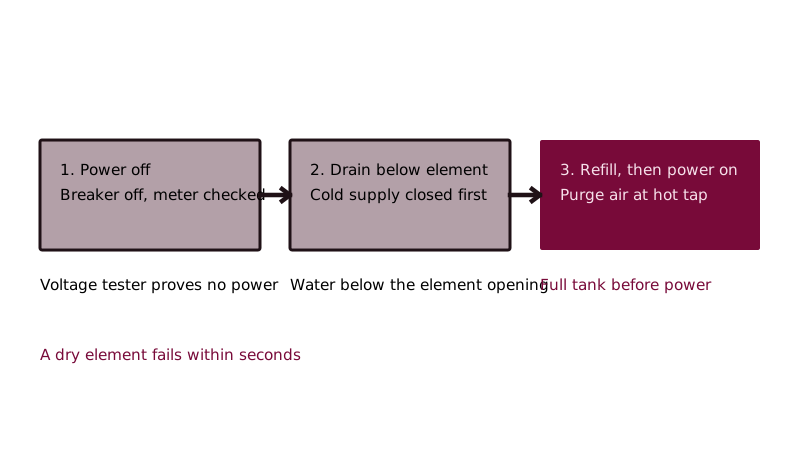
Three steps are commonly botched:
- Test first. With wires removed, set the multimeter to a low ohms range and touch the two terminals. Manuals cite readings in the range of roughly 10 to 30 ohms for common elements; check the element's rating. A reading of zero or OL means dead. A reading between a terminal and the tank flange means a ground fault, which also means replace.
- Drain enough. Water must sit below the element opening. Opening a hot tap or the relief valve lets air in and speeds drainage.
- Refill before power. Run a hot faucet until water flows steadily and air stops sputtering. Only then switch the breaker on. A full tank can take a couple of hours to come up to temperature, one manufacturer notes.
Do not over-tighten a screw-in element; it can crack the gasket seat or damage the threads.
Can a homeowner swap an element safely?
Only with the power dead. Flip the breaker, pull the access cover and insulation, and prove with a voltage tester that no current reaches the terminals. Water and 240-volt wiring together can kill, so hire a plumber or electrician if any step is murky.
Never power up a tank that is not full. An element running dry cooks itself within seconds. Fill the tank, let a hot tap run until air stops spitting, and only then restore the breaker, which is what the manufacturers' manuals say.
Some situations are not for amateurs: corroded wiring, scorched insulation, a flange that weeps, an element seized in place. Replacing the whole heater is different: that work needs a permit in California, and a contractor license applies to jobs of $1,000 or more in labor and materials.
What should be on the bench before you start?
Gather an element that matches the data plate in voltage, wattage and mounting (screw-in or bolt-on flange), an element wrench or deep 1-1/2 inch socket, a meter and voltage tester, a screwdriver, a hose and bucket, and a gasket, which often comes in the box.
Start with the data plate. A higher wattage than specified can overload the wiring; a lower one just heats slower. Upper and lower elements are sometimes different wattages. Some heaters use low-density elements to reduce scale, and a heater model number lets a parts counter find the exact fit.
Check that you have the right gasket, because a reused or flattened one can weep. Keep a flashlight handy and photograph the wiring before disconnecting anything.
When does it make sense to call a plumber?
Call one if water seeps at the element flange, wires look damaged, the new part trips the breaker, you cannot prove the power is off, or the tank is aging and failing in several ways. Thermostat testing can happen on the same visit, and the plumber can say if repair still pays.
Want it done for you? Use the price request and a local plumber arranges a visit. Other work is listed on the home page.
Common questions
Which element goes bad first, the upper or lower?
Bottom elements go first more often, since silt and scale settle around them. The upper one is more often a thermostat story, which a meter test will sort out. The upper element is less often to blame, though a failed upper thermostat or element gives the more dramatic symptom of no hot water at all.
Can I use any element that fits the opening?
No. Voltage, wattage and mounting style must all match the data plate, and a mismatch can overload wiring or leave you with weak heat. A wrong wattage can overload wiring or underperform. Bring the old element, or the heater model number, to the parts counter to get the right fit.
How long does a new water heater element last?
No set lifespan exists. Elements can last many years in clean water and fail early in scale-prone water or after dry firing. If an element burns out within a year or two, look for sediment, a bad thermostat or a wiring issue instead of just replacing it again.
Do I have to drain the whole tank?
Not necessarily. The water level only has to fall below the opening, though for the bottom element that means emptying most of the tank. Close the cold supply and cut power first, and refill fully before power returns, because a dry element fails within seconds.
Does one dead element mean a whole new heater?
Rarely. One failed element in an otherwise healthy tank is a modest fix. If the tank leaks, rusts at the seams or has outlived a normal life, replacement tends to win, and an inspection by a plumber will show which case you have, so you are not guessing.