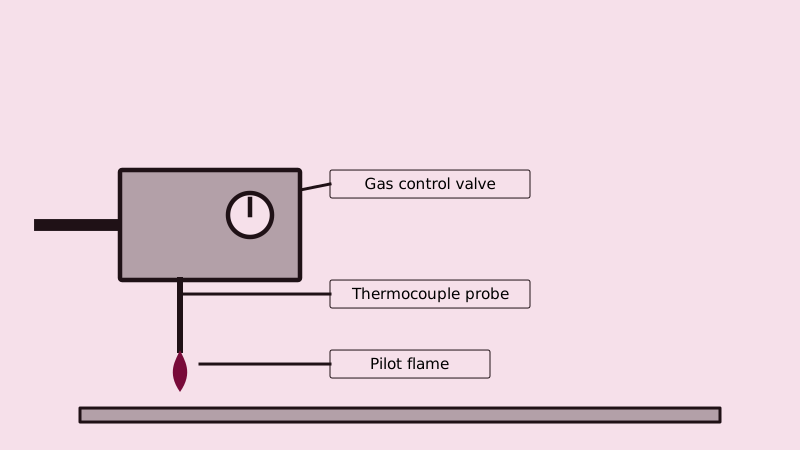
Light the pilot, hold the knob, let go, and a few seconds later the flame is gone again. That routine is the textbook thermocouple failure. The part costs little and guards against a serious fault, so it is worth understanding before you give up on a stubborn heater. The tank, burner and controls around it are explained across the water heater repair section.
How does a thermocouple keep the pilot lit?
The probe's tip is bathed by the pilot flame. That heat produces a tiny voltage, and the voltage tells the gas valve to hold its position. If the flame vanishes, the tip cools, the voltage fades, and the valve closes before raw gas can pour out. A worn probe cannot generate enough voltage even beside a perfectly good flame.
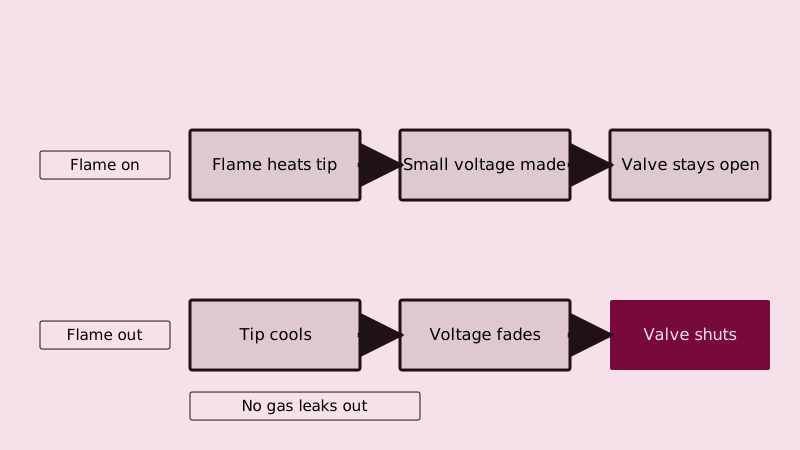
Wikipedia calls this a fail-safe. The safe failure is a cold heater, not a gas leak, which is good engineering but makes a weak thermocouple look like a baffling pilot problem.
Two variations exist. A thermopile bundles several thermocouples and also runs the gas valve on some heaters. Heaters with electronic ignition run without a standing pilot, so the part plays a different role there, or none. The data label on your heater shows which design you own.
Which symptoms point at the thermocouple?
Classic sign: the pilot lights only while the knob is held down and dies shortly after release. A second sign is a pilot that survives a day or two and then quits. A steady pilot with a burner that never fires is a different story, aimed more at the gas valve or the thermostat.
Run through these look-only checks before buying anything:
- Does the pilot flame wrap around the probe tip, or does it drift to one side?
- Is the tip sooty, bent or crusted?
- Is the pilot orifice clogged with lint from a dusty garage closet?
- Is a breeze through the closet door or vent tickling the flame?
None of that opens a gas line. If the air ever smells of gas, you stop on the spot. Step outside, then ring SoCalGas (1-800-427-2200) from the curb. Anyone at risk? Dial 911 as well.
Could a capable homeowner do this swap?
Some do, because the probe unscrews at the gas control valve. Still, it is gas appliance work, and California regulates gas piping. The legal line sits at piping and permitted work, yet a badly seated fitting at the control valve can leak all the same. If you hesitate, book someone.
Those who proceed shut the gas control, let the heater cool and buy a part matched to the model, because lengths and fittings differ. After tightening, brush soapy water on every joint touched and watch for bubbles before relighting. Never hunt a leak with a flame.
A damaged control valve, a leaking pilot tube or crusty old fittings change the picture. That stops being a part swap. Gas line questions have their own page, gas line plumbing.
What happens during a professional swap?
First the diagnosis is confirmed. Then gas is shut at the heater, the old probe comes out of the control valve and pilot bracket, and a matching one goes in. The pilot is relit and the flame, draft and every touched joint are checked. A thorough visit also glances at venting and combustion air.
Sometimes the visit explains the failure. Poor draft, a dirty pilot assembly or a tank in its last years can mean the new part only buys time. That information helps you decide how much more to put into the heater.
Permit rules for a lone part swap are the city's to answer. A full replacement does need one, as described in permits for water heater work.
Does a new thermocouple make sense on an old tank?
Usually, so long as the tank has no leaks or rust and the heater is not ancient. It is a small repair next to a new tank. Once the tank weeps, rusts through or collects other faults, the money belongs toward a new heater. The age printed on the label tips the balance.
Hardness plays a part around Whittier. The city's own 2025 water quality report gives total hardness averaging 250 mg/L, and scale can shorten tank life while the burner behaves. For the lifespan side read when a heater should be replaced, and for the money side water heater replacement cost.
What should an estimate list?
The part, the labor, a look at venting and gas connections, plus what follows if the pilot still refuses to stay lit and whether a trip fee is credited. Request a repair figure beside a replacement figure so the choice is obvious.
Make, model and age speed things up, and the label glued to the tank carries all three. Add a photo and your symptoms to the price request form.
Common questions
What kills a pilot over and over?
A tired thermocouple tops the list, then a dirty pilot opening, a draft, and a failing gas valve. Death within seconds of releasing the knob usually means the probe. If a fresh probe fails the same way, the control valve or airflow around the heater needs a look.
How long should a probe last?
There is no set number. Some run for years and fail suddenly, with heat, corrosion and soot wearing them down. Because the part is cheap and acts as a safety device, plumbers often change it while they already have the pilot assembly out. The heater's overall age is the better guide.
Is it wise to keep relighting a stubborn pilot?
No. Two careful tries is plenty, because a pilot that drops out keeps pointing to a fault worth finding. Never strike a light while you smell gas. Get everyone out of the building, then ring the same SoCalGas number from a safe distance.
Do newer heaters still use one?
Many gas tanks do, as a thermocouple or thermopile. Electronic ignition models drop the standing pilot. Wikipedia notes some tankless heaters also use a thermocouple as a cutoff if the flame fails. Your manual or data label settles which design you have.
Does the city care about a probe swap?
For a lone probe, ask Whittier's Building and Safety office at (562) 567-9320, since we cannot answer for the city. A new heater is permitted work, as is any gas piping change. Should the visit become a replacement, the plumber arranges the paperwork. Other work we line up starts at the home page.